April 26, 2025
Imagine a future where medicine goes straight to the sick cells. This means fewer side effects and better treatment results. Breakthroughs show that almost 70% of cancer treatments could work better with nanorobots for targeted drug delivery.
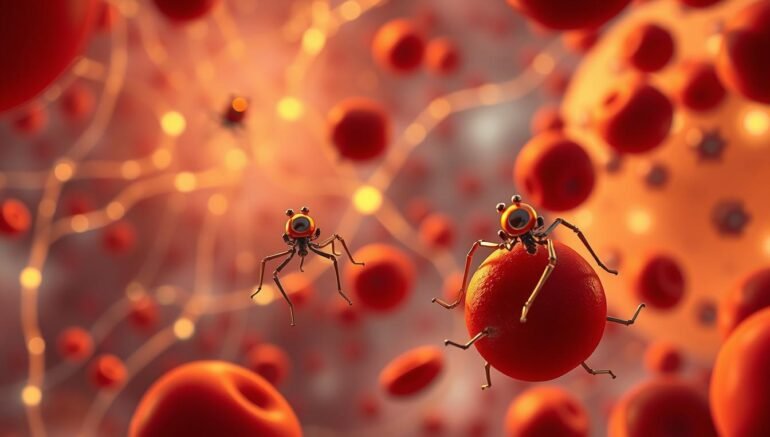
These tiny robots are made to move through the body. They find their way to specific areas to deliver drugs right to the cells or tissues.
You’re on the edge of a major medical breakthrough. Cellular level treatment is becoming a reality. With nanorobots, doctors can change how we treat diseases. Treatments will be more precise, and healthy cells will be safer.
Key Takeaways
- Nanorobots can be designed to deliver therapeutic agents directly to specific cells or tissues.
- The use of nanorobots in medicine could significantly reduce systemic side effects.
- Treatments become more effective as drugs are delivered precisely where needed.
- Nanorobots are engineered to be biocompatible and navigate through bodily fluids.
- They release their payloads in response to specific stimuli, enhancing treatment efficacy.
The Evolution of Nanomedicine
You are on the cusp of a revolution in medicine. This is thanks to the evolution of nanorobots, which have moved from science fiction to real-world use. The field of nanomedicine has seen big advances. It’s now changing how we treat diseases at the cellular level.
From Science Fiction to Scientific Reality
The idea of nanorobots was once seen as science fiction. But, breakthroughs in materials science, robotics, and biomedical engineering have made it real. Scientists have made nanorobots that can move through our bodies. They can also deliver medicine to specific areas.
“The development of nanorobots represents a significant milestone in the field of nanomedicine, offering new avenues for disease treatment and diagnosis.”
Key Milestones in Nanorobot Development
There have been several important milestones in nanorobot development. These include nanorobots that can move on their own, target specific cells, and release medicine as needed.
| Milestone | Description | Year Achieved |
|---|---|---|
| Autonomous Movement | Nanorobots capable of moving through bodily fluids without external guidance. | 2015 |
| Targeted Drug Delivery | Nanorobots designed to deliver drugs to specific cells or tissues. | 2018 |
| Controlled Release Technologies | Mechanisms developed to control the release of therapeutic agents from nanorobots. | 2020 |
Understanding Nanorobots: Microscopic Machines
Nanorobots are tiny machines that work at the cellular level. They are microscopic machines designed for specific tasks. This makes them very useful in medicine.
Definition and Scale
Nanorobots are tiny machines that can change energy into movement. They work at the nanometer scale. This size is key for them to interact with cells.
This size is important for their use in medicine. It helps them deliver drugs to the right place.
Components and Structure
Nanorobots have different parts like sensors and propulsion systems. They also have spaces for carrying drugs. These parts help them move through the body.
The propulsion systems are what make them move. They are very important.
Propulsion and Navigation Systems
Nanorobots use propulsion and navigation systems to move. They can be powered by outside sources or by themselves. This lets them go to specific places in the body.
The main things about nanorobot movement include:
- External power sources like magnetic fields
- Internal mechanisms such as chemical reactions
- Advanced navigation systems for targeting
Nanorobots in Medicine: Targeted Drug Delivery at the Cellular Level
Nanorobots are being made to move through the body and reach sick cells or tissues. They can carry drugs right to the problem areas. This could change how we treat diseases by reducing side effects and making treatments work better.
Principles of Targeted Drug Delivery
The success of nanorobots in drug delivery depends on a few important things. Specificity is key, making sure nanorobots find and target sick cells but not healthy ones. They do this by using cellular recognition mechanisms to attach to specific receptors on target cells.
Cellular Recognition Mechanisms
Cellular recognition is essential for targeted drug delivery. Nanorobots have special molecules on their surface that can find and stick to receptors on sick cells. This lets them deliver drugs right to the problem areas, making treatments more effective.
Controlled Release Technologies
Controlled release technologies are crucial for getting the drug to the right place. Different things like pH, temperature, or enzymes can make the drug come out of the nanorobots. This ensures the drug is released exactly where it’s needed, boosting its effectiveness.
How Nanorobots Navigate the Human Body
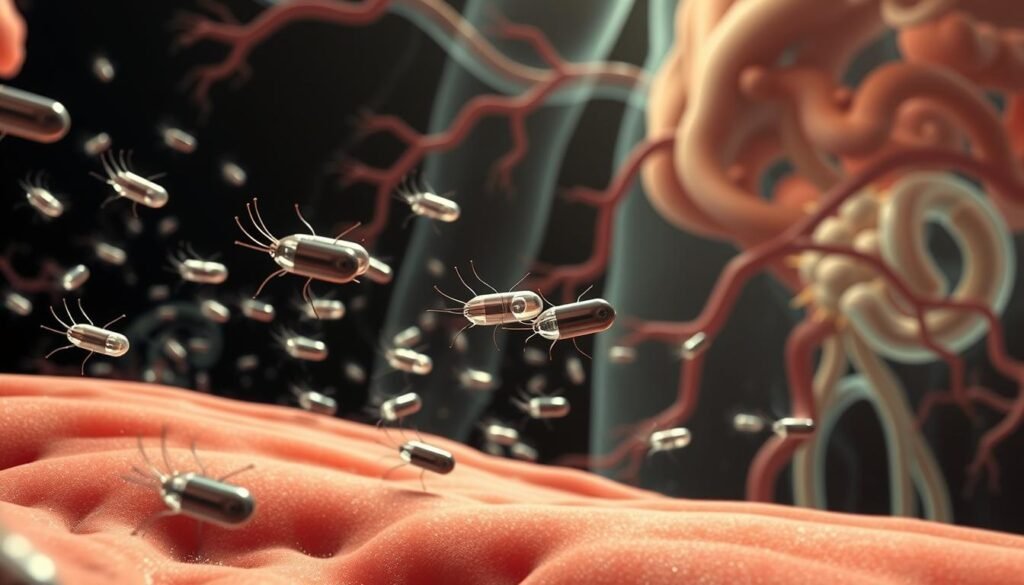
Nanorobots need to move through the human body’s complex paths, like the bloodstream. They face big hurdles, like avoiding the immune system and finding their way to their targets.
Bloodstream Navigation Challenges
In the bloodstream, nanorobots deal with tough issues. They must handle turbulent flow dynamics and interactions with cells and proteins. They use advanced propulsion mechanisms, like magnetic or ultrasound, to move well.
Targeting Specific Cells and Tissues
Nanorobots aim to reach specific cells or tissues for medical help. They use targeting ligands on their surface. These ligands help them bind to certain cells, ensuring the right treatment is delivered.
Overcoming Biological Barriers
Some treatments need nanorobots to cross barriers, like the blood-brain barrier. New designs and materials are being made to help them get past these barriers. This opens up more possibilities for medical use.
By tackling these challenges, nanorobots can better navigate the human body. This leads to new ways to deliver drugs and other medical treatments.
Clinical Applications and Treatment Areas
Nanorobots are changing how we treat diseases. They are key in targeted drug delivery. This is a big change in treating diseases.
Cancer Treatment Revolution
Nanorobots are making cancer treatment better. They deliver drugs right to tumors. This means less harm to healthy cells and better results.
They can find and stick to cancer cells. This ensures the drugs go exactly where they’re needed.
Cardiovascular Disease Interventions
Nanorobots are a new hope for heart diseases. They can go through the blood to reach specific spots, like atherosclerotic plaques. This could slow down heart disease and help patients more.
Neurological Disorder Treatments
Nanorobots might help with brain diseases too. They can get past the blood-brain barrier to reach the brain. This could help with tough-to-treat brain conditions.
| Disease Category | Nanorobot Application | Potential Benefits |
|---|---|---|
| Cancer | Targeted chemotherapy delivery | Reduced side effects, improved efficacy |
| Cardiovascular Disease | Drug delivery to atherosclerotic plaques | Reduced disease progression |
| Neurological Disorders | Crossing blood-brain barrier for therapy | Effective treatment of previously hard-to-treat conditions |
As research gets better, nanorobots will help more. They offer new hope for people with many diseases.
Challenges and Limitations in Nanorobot Medicine
Nanorobot medicine is on the verge of a major breakthrough. But, it faces technical, biological, and regulatory hurdles. Understanding these challenges is key to unlocking nanorobots’ full potential in medicine.
Technical Engineering Hurdles
Developing nanorobots for medical use is a big challenge. Nanorobots need to work well in the human body, moving through fluids and tissues. They require advanced systems for navigation and control.
Researchers are looking into various ways to guide nanorobots. This includes using magnetic fields or ultrasound. But, these methods are still in the early stages.
Biological Compatibility Issues
Ensuring nanorobots are biologically compatible is a major challenge. Nanorobots must avoid immune reactions and toxicity. This is hard because they are foreign to the body. The materials and surface properties of nanorobots must be carefully designed to be safe.
Experts say, “Understanding how nanorobots interact with the body is crucial. It requires knowledge of both the nanorobot and the biological environment.”
Regulatory and Ethical Considerations
Regulatory and ethical issues also need to be addressed. Nanorobots must be proven safe and effective. There are also ethical concerns, like privacy, consent, and fairness in access.
As research moves forward, tackling these challenges is essential. Overcoming technical, biological, and regulatory obstacles will unlock nanorobot medicine’s potential. This will lead to new treatments that can greatly improve patient care.
Future Prospects of Nanorobot Technology
Nanorobot technology is growing fast, with big hopes for medicine. It’s getting better, thanks to ongoing research. This makes us excited for what’s to come.
Next-Generation Nanorobot Designs
New nanorobots are being made with better ways to move and find their targets. They can now go deeper into the body and reach sick cells more easily. For example, nanorobots with magnetic propulsion might be controlled from outside, making them even more precise.
Integration with Other Medical Technologies
Scientists are also working on combining nanorobots with other medical tools. This could let us watch nanorobots work in real time and make treatments better. By linking nanorobotics with advanced imaging, we might learn even more about how these tiny machines work inside us.
Timeline for Clinical Implementation
The time when nanorobots will be used in hospitals is getting closer. Researchers are tackling the big challenges that need to be solved. Soon, we’ll see the first clinical trials, starting a new chapter in how we treat diseases.
The outlook for nanorobot technology in medicine is very promising. It could change how we treat many illnesses. As research keeps moving forward, we’re looking forward to seeing it used in hospitals.
Conclusion
Nanorobots are changing medicine by delivering drugs directly to cells. This could make treatments work better and have fewer side effects. It’s a big step forward in research.
These tiny robots are designed to move through the body, find specific cells, and release drugs. This is a huge leap in medical technology.
As technology gets better, nanorobots will play a bigger role in treating diseases. They could bring new hope to many people. The future of medicine looks bright with nanorobots leading the way.
FAQ
What are nanorobots and how do they work in medicine?
Nanorobots are tiny machines that help with medical tasks. They can deliver drugs directly to cells. This makes treatments work better and have fewer side effects.
How do nanorobots navigate through the bloodstream?
They use special ways to move, like magnets or sound waves. They also have parts that help them find and stick to specific cells or tissues.
What are the key principles of targeted drug delivery using nanorobots?
They use special ways to find and stick to cells. Then, they release the drug in the right place. This makes sure the treatment works best where it’s needed.
What are the potential clinical applications of nanorobots?
They can help with many diseases, like cancer and heart problems. They can even treat brain disorders. This opens up new ways to fight diseases at the cell level.
What challenges need to be addressed for the clinical implementation of nanorobots?
We need to solve technical problems and make sure they’re safe. We also have to think about rules and ethics.
How are nanorobots designed to overcome biological barriers?
They’re made with special designs and materials. This lets them get past barriers, like the blood-brain barrier, to reach where they need to go.
What is the future of nanorobot technology in medicine?
The future looks bright. Advances in design and materials are making them better. We can expect big steps forward in using nanorobots in medicine.
How do nanorobots improve treatment efficacy?
They deliver drugs right to the problem areas. This means less harm to healthy cells. It also cuts down on side effects.